Showing posts with label Theatre and Film Reviews. Show all posts

Friday, 23 March 2012

The 3 Baritones


I am a little late in posting this, sorry. On Sunday, I was railroaded by the Grandmothership into a trip to Muson. Although I say railroaded, I do love a bit of culture on a Sunday afternoon, especially on a Sunday like the last one where I'd spent the better part of three hours, stuffing myself silly at the Southern Sun; and was in desperate need of something to distract me from how full I was!

The 3 Baritones, Obinna Ifediora, Olumide Dada and John-Paul Ochei apparently met at a house party given by The Godfather of Lagos, Tinubu, in 2006, where they had each been invited to perform. They have been performing together since.

The concert was well curated, and gave us a chance to experience both their individual and collective sound. Ifediora, whose voice I recognised instantly from his part as the Pirate King in 'The Pirates of Penzance' which showed at Muson a couple of weeks ago, has a distinctive flair. His voice is rounded and rich, and deep but with a featherlight tenor touch that makes his singing sound effortless. His rendition of Mozart's Non Piu Andrai from The Marriage of Figaro was true to the original form but benefitted from his own interpretation too, and you can see from his expressiveness that he is in possession of a special kind of emotional intelligence. I reckon he'd make a great actor too!

Listening to Olumide Dada's versions of 'Pieta Signor' by Stradella and 'Alright, Okay, You Win' were like listening to a CD. His voice is the easy drinking red wine of the lot, and yet, technically, the truest baritone. The tension between those features creates this velvety and sonorous sound that puts you at ease enough for you to stop actively listening. You kind of come to once he's stopped singing with the feeling of having had some good thoughts but not being really alert enough to articulate them. That's a compliment! He's good, and definitely one to watch. 

John-Paul Ochei, I also recognised from his role as the head policeman in 'The Pirates of Penzance'. Those of you who saw the show will remember him as the police man with the hilarious wobbly-headed walk. He brings a wicked comic streak to his performances and his delivery of Largo Factorum by Gioacchino Rossini was no different. I especially enjoyed this performance because my relationship with this piece goes way back to my childhood. Do you know, that the piece features in a major way in the Tom & Jerry Cartoon series? I remember Tom singing it all the time and to this end, I practically know all the words. Myself and the Sistership had an awesome time singing along, despite the quizzical looks from people sitting around us. I guess the message is: cartoons aren't all bad and they may actually reinforce your kids interest in classical music. I did think on his piece from Roger and Hammerstein's South Pacific that he needs a little bit more coaching on projection, and range but all in all a good performance and his enthusiasm on stage is infectious.

Together, the 3 Baritones have an endearing sound and they have managed to find a good harmony with a mixture of pieces in Yoruba and English, ranging from Ayo Bankole to John Lennon and Paul McCartney. I like the fact that they are very simply accompanied, by just a piano, the double bass, some drums and a sax. It makes for a well rounded but uncluttered sound. 

Friday, 9 March 2012

The Man with Weak Ankles

Sometimes, it feels like the written word acquires life all on its own and finds a way to come true. Last week, at an event, I was so rubbed up the wrong way by one of the performers that I bashed out a quick piece on my phone on how he irked me. Tonight, prior to the commencement of the same event, his awfulness came up in conversation and I was forced to admit to some friends that his unsavoury self had given me an enraged flash of inspiration to count the many ways in which I do not love him. The event itself is great and I wish they wouldn't let him sully it. My friends, on reading my "rage review" piece called me mean, and made various feline noises because they thought I was being catty and vindictive. They hadn't picked up on some of his less choice characteristics. Needless to say, after his repeat performance tonight, they were up and cheering, falling about in stitches. Not because his set was any good but because, with his very own mouth, he totally implicated himself and it turned out that I was RIGHT rather than mean about him.

Ladies and gentlemen, I present to you, my flash in the pan "rage review" of a performer I have Christened, "The Man With Weak Ankles"...


The male form can be let down by the jointing of its ankles. The male form is not properly resolved unless he has good legs and good feet. The specimen who have weak ankles, with feet not squarely placed on the ground but tilting slightly outward, seemingly splayed and cursed un-parallel by awkward knees is a sign - no, a certain indication - of duplicity, misogyny, and vainglorious falibility. They are the type of men whose feet are indeed flippers, designed for treading quick sand and bearing them stealthily to all manner of destinations, except those to which they profess they have been.

Such was he, the ugly oaf like rapper who mounted the stage this Thursday evening, proselytising about a pimply 6'4" woman who was a pretty little bitch on the outside but ugly inside, how he used to be pretty inside and now, thanks to her he was now ugly inside. It was not necessary to forgive him his apparel, to give him the benefit of the doubt and ignore his badly drawn American dreams; I understood then that my diagnosis of his inferior mental state based on his roughshod skeletal infrastructure was spot on. The blame-dispensing, under-achieving, and lascivious fool.

His dishonesty is all too obvious to me, if not to everyone else. His claim to musical prowess lies in his pre-fabricated rapper persona; and yet his most damning revelation is nestled in his inadvertent admission that he gets used and abused by questionable, gargantuan women who have no beauty or skin care regimen to speak of. I wager that he also gets dismissed by the gorgeous, tall, leggy ladies, who don't acknowledge his being alive because he is so far removed from even the most elemntary levels of human accomplishment.

The disdain tonic he has brewed on account of said women (neither of whom want him) he now sweats out with malarial intensity, strained and rebottled with extra spices for an unsuspecting audience whom he tricked into believing they'd be getting some genuine creativity and music.

My message to the man with weak ankles is this: 'Oh ye with your cap back to front at your age, poor you, shame, you are inconsequential and lame.'

Wednesday, 29 February 2012

Colossal Waste of Time

I decided last night that following a fairly gruelling day, I deserved to tuck myself into bed with a movie. Now, I am in no way a film buff. My criteria is this: I like a good Romcom or Drama or Action Thriller with just enough intrigue to keep me engaged, but not enough weirdness to get the real film buffs excited (that is the point where I fall asleep).

Also, if I am to watch anything, my preference is for it to be from the comfort of my sofa at home. I don't understand why anyone would want to sit in a dark room with hundreds of strangers, very many of whom are unsavoury, and all of whom are potential obstacles blocking you from the fire exit, should you ever need to use it in an emergency. I do however love popcorn and have been known to buy the popcorn and skip the movie. This is not to say that I never go to the cinema; just that it is not my favourite place in the whole wide world to be. I prefer to watch stuff at home, where the possibility of smug, fat rats scuttling up the walls isn't at 80% and I don't have to wonder about the virulent bacteria that proliferate in places like cinemas that shun the occasional, redeeming light of day.

But now at least you understand how I don't turn to film by default the way some people do, and how I despise going to the cinema. So the opportunity cost is huge for me if I decide that I will watch a film, rather than read the ever growing pile of books I am eager to get through.
So you can imagine my disappointment when I watched Karate Kid (with the little Smith boy) for the first time yesterday. Is this really what people have been raving about? Glad I didn't pay to see that in the cinema!

Oh what poorly rendered characters. How simplistic and underdeveloped they were. Why was the mother so stereotypically African American, whoopin' and hollerin' every other minute? Why did the kid have to be called 'Dre AND have such a foul personality? And how insulting that they would have us believe that his great internal discipline was learnt by being made to pick his jacket up a few times by the random Kung Fu gentle giant down the road. It was an inadequate acknowledgement of the need to break his obstinacy, and the transformation of his character was no where near sincere enough. How immature the pen that wrote the script; where 'Dre's eulogistic glory came from winning the very first tournament he ever competed in. I mean really? We all know his character needed to have been broken a few more times, defined by a few more challenges.

Maybe it could have worked as a silent film for spastics (very basic plot, inconsequential dialogue and one dimensional characters) but not really my cup of tea, thanks.
What a colossal waste of time and it wasn't at all worth the ache in my neck and arm from propping myself up in bed to watch it. That's two hours of my life I won't ever get back.

Jackie Chan my dear, the despairing, tortured character thing isn't really your style. Here is one situation in which you need to #staywithinyourcomfortzone. I like you much better when you're doing happy kung fu! And the little Smith boy has a ways to go before he is ready to be a convincing actor.

Sunday, 5 April 2009

Sisters in Law


In my personality, there are two extremes. There's the slick me who likes things plush and luxurious and then there's the grungy me who likes things slightly messy and unpolished. I alternate unpredictably between the two, but this weekend, I've been very much in a grungy phase. Imagine how delighted I was on Saturday afternoon when I remembered I was due to attend a film screening in the headquarters of all things arty and disheveled - Shoreditch!

Feeling bright-eyed and bushy-tailed because of the lovely weather, I headed down there with my partner in crime and was utterly pleased to find that the venue, Charlie Wrights International Bar, was as Shoreditch as they come. Ecclectic mismatched furniture, scuffed floors, odd stuff on the walls, the faint smell of disinfectant and all sorts of other elements of shabby insousiance...

The screening was put on by a group called Screening Africa, run by my friend Joseph. Once every two months, they show a thought provoking film of African interest accompanied by some delicious African (on this occassion, Nigerian) food.

Sisters in Law, directed by Kim Longinotto is an award-winning and uplifting documentary film focusing on justice in the village of Kumba Town, Cameroon. The town is overseen by the progressive female partnership of a prosecutor and court president, who together help women to speak out and fight back against entrenched roles in society.

While we were spared the gory details, we got to meet a whole group of women and children who had been raped, abused, and beaten to within an inch of their lives by the men in their communities. We saw their pain, and watched them fight victoriously for their rights even amid pressure to drop the case by society.

Far from being a depresseing film though, there were elements of humour to be found in the direct no-frills justice of the legal professionals and the lousy excuses given by all the convicted criminals: 'Please have mercy on me. I am an orphan and I have no one. Punish me but please don't punish me too harshly...'. Puh-lease!

It's a brilliant piece of work a) because it's enlighteneing and b) because it confronts difficult issues head-on without painting Africa in a bad light, which many of these documentaries seem to do. It emphasised hope and progress and liberty rather than injustice, backwardness and ignorance which I imagine is what made it a favourite at worldwide film festivals including the Cannes Film Festival and took it to the last 15 of the Oscar Best Documentary shorlist.

Unfortunately the director couldn't make it or I would have tried to bag an interview. If you'd like to watch it, I believe you can do so via this link

Enjoy!

Thursday, 7 June 2007

Big White Fog


Images from www.almeida.co.uk
After I saw this play, I realised that my opinions from a previous post (Origins and Where We’re From) might actually be flawed. Theodore Ward’s Big White Fog, directed by Michael Attenborough, no less, has had a grand welcome from the literary circuit. It was discovered quite recently to have been written before A Raisin in the Sun, which until now was known as the first Afro-American mainstream play. Basically, it covers the experiences of the Mason family, when Vic the father ties up his family’s life savings in Marcus Garvey’s shipping line which never materialised. He ended up losing the money, his children dropped out of school, and his daughter began to play pay-per-touch with her body to help her mother take care of the younger siblings. Of course the very same father turned round and called her a whore, complained to his wife that she should fix the kid’s leaking shoes etc, conveniently forgetting that it was his royal highness who kicked them to the bottom of the poverty line in the first place.

The subtext and the inter-family relations outdoored all the most pertinent issues of the time: Black on Black attitudes that came with different shades of lightness of darkness, the political climate, etc. But what made me think the most were Vic and Dan’s opposing views which related directly to my post. Vic was following Garvey and trying to claim Africa for the Africans. He got promoted to something like Overseer of the Grounds and Goats, ahead of their planned return to Africa. Dan, however, declared that he was American because he was born there. In a nutshell, Big Whit Fog dramaised the conflict between The American Dream and the Back to Africa schools of thought, and how the different ideologies affected the Mason family during the Depression.

By the end of the play, I had moved from siding with Vic to siding with Dan, at least somewhat. Dan thought that The Garvey idea was just another way of perpetrating segregation, and a hoax. I now agree that from-ness is not always absolutely about where your parents are from, but a combination of factors. And so I stand corrected. It was silly for Vic to assume that he would automatically be a land baron in Africa, and silly, I think, for the Garvey squad to bestow such an honour on him; it wasn’t their place. It betrayed a condescending attitude towards the people who were already living there – why would Vic and his superiors assume that those who had been in Africa always and never left would gladly step aside and relinquish agricultural control of their land to strangers? The notion also irked me because it took the quintessential standpoint of Africa as a table top that many ignorant people tend to adopt. Did Garvey know how large Africa was? Did he know that there are way over 15000 different cultures rooted there? Did he know that he wasn’t the only one with his eye on the prize, and that it wouldn’t be so easy to just waltz in?

I am not yet a Garvey scholar, so forgive me if my rants are off the mark, and I will go away and do some reading; but these were the issues thrown up by the play (which I have on trusted authority) as being quite historically accurate. Nevertheless, Dan turned out to be right, and there was a huge cathartic situation at the end, where Vic got shot (served him right; I liked him, but it was poetic for him to die), and his son Les, and his other friends resisted eviction by the Mayor’s cohorts.

The only factor that I found slightly chilling, was that the last scene seemed like a thinly veiled attempt to endorse socialism. I mean, come on! But I won’t get into that today; my opinions on socialism etc tend to degenerate very fast into expletives, and this is neither the time or the place, so I shall spare you the aggro.

That said, it was possibly the best bit of theatre I’ve seen so far. The set was the work of a brainchild. It felt like we were sitting in someone’s living room, eavesdropping on their conversations. Without any gushing or histrionics, I’d encourage everyone to go and see it. Believe it or not, there are some hugely comic scenes in there, what with the snide old grandmother and her pearls of wisdom.

Big White Fog shows at the Almeida Theatre until 30th June, 2007.
Tickets from £6 - £29.50
http://www.almeida.co.uk/

Thursday, 31 May 2007

Modernity and Emasculation


A new disease has crept insiduously upon humanity. I’m being generous by saying humanity. What I really mean is men; a disease has crept insiduously upon the men of today’s world. What do I mean? Well it’s quite simple really.

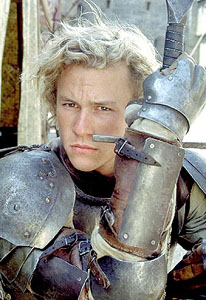
I was thinking about the movie, A Knight’s Tale (starring Shannyn Sossamon, Rufus Sewell, Heath Ledger) and how much wisdom there is embedded in it. If you haven’t watched it, please run out and buy/rent it. You’ll see this post in a new light. Basically, there was a jousting tournament and the winner would get to have the princess Jocelyn’s hand in marriage. In those days, when they said ‘may the best man win’, it was perfectly logical that the woman would choose to be with the best man. And the men rose to the challenge. If a man found a woman out of his league because he lost a challenge or wasn’t able to support her, he went away to make himself better, fully understanding that the woman would do the best she could for herself by choosing the best man in every situation. He’d ride gallantly away and wish her luck. He’d be a good sportsman and acknowledge his loss gracefully.

Now, men have been emasculated and are afraid of competition. If a woman picks the best man for herself, the left out guy will huff off in a sulk and rather than find ways to improve him self, accuse her of being ‘materialistic’ and a ‘gold digger’. He’ll sit there feeling sorry for himself, slagging women off about how they’re all the same. I’ve seen this happen a million times, and I think, stop moping and feeling sorry for yourself. Either you upgrade yourself to the level where you can attain the type of women you want, or you settle for a woman who is in your leaugue, but you can’t expect a woman to lower her standards because you’re not up to hers. According to Jeanette Winterson, ‘Sometimes you win. Sometimes you lose.’ If you happen to be male, take it from me, your dignity is better preserved when you can own up to certain inadquacies and work on them. Wallowing in self pity is just really sad, and we will leave you for the better man. Hahaha.

Jane Austen remained single all her life because the man she loved couldn’t afford to maintain the standard of living to which she was accustomed. The husband-to-be-that-never-was did not resent her, because he acknowledged that there was no point in reducing her to squalor just for the sake of his own ego. So they conducted their relationship happily, pragmatically, and he never accused her of being materialistic or a gold digger. She was neither. She was a smart woman, and he was a smart man.

Oh for the days when men fully expected to have to compete for the things they wanted. Now they want women to make things easy for them and dive headlong into compromised situations to prove they aren’t ‘materialistic’. I admit, some women take things a bit too far, but for the most part, men have simply lost their balls. Some of them would rather buy a bride on ebay than spear a wild boar for the love of their life.

Spear me a boar, I say.

Friday, 27 April 2007

Oh Louder, Baby!


Slavery poster from: www.valley-entertainment.com


Olaudah Equiano, or oh- louder as he was mockingly called before the forceful changing of his name to Gustav Vassa; what a celebrity he’s become! Ever since the release of feature film Amazing Grace in March 2007, his name has been bandied about over dinner, over drinks, over the airwaves – endlessly. As I missed the fanfare surrounding his premiere into mainstream consciousness, I had the honour of meeting him today, in a play, African Snow, performed by the Riding Lights Theatre Company. Quite different, I must say, from old familiar Kunta Kinte. Partly, I suppose, due to the fact that Equiano’s account is autobiographical, not quasi-fictional.

I went in there prepared to be disgusted by a Western over-rendered impression of African-ness; by convoluted facts and dramatised excuses. After all, just last month, a sweet looking old lady told my sister and I at the V&A’s Uncomfortable Truths exhibition that slavery wasn’t necessarily bad because ‘the poor slave masters didn’t know any better, the poor souls.’ Probably the wrong thing to say to two proud Nigerian girls on a hot afternoon, but her blush showed us that she obviously didn’t mean it how it came out, so we smiled at her elderly brain fart and moved on.

Nevertheless, that sort of sentiment is what I expected, and I was pleasantly surprised when I found my pre-programmed disapproval challenged. African Snow was a charming discourse between John Newton, writer of the hymn Amazing Grace, and Olaudah Equiano, freed slave turned Parliamentary circuit speaker.

What appealed to me most, was the robustness of the dialogue. The imagery was hauntingly poignant yet not conspicuous. Equiano, gifted with words, sustained moving monologues in a verbal travelogue that led us on the commute between his actual freedom (before he was stolen from the coast of West Africa) and the shifted goal post or redefined freedom (the day he bought his own freedom for 40 guineas). Newton’s rendition of his journey to spiritual enlightenment that caused him to join the Abolitionist cause was made more accessible by the portrayal of his thoughts through his hymns. The combination of these two commentaries, both poetic, both emotional, both raw, worked together elegantly, like an antagonistic pair of muscles. And how’s this for a tasty dramatic subversion – old Wilberforce was played by a black man!

The stage set must be mentioned and praised very highly! A slatted wooden contraption sat at a forty-five degree angle on the stage, in some scenes a ship, and in others representative of the shadow of depravity that many souls wriggled under. Admittedly, African Snow’s concern with the condition of the human soul is one that everyone can appreciate, whatever side of the slavery argument one comes down on.

It’s a good piece of theatre. I would recommend seeing it, if only just to have a new addition to your modern collection of opinions which by now, if you’re truly up to date, should include organic clothing, climate change, and the cancelled Royal engagement at the very least.

African Snow tours nationally until June 30th, 2007.


© April 2007

 
Blogger design by suckmylolly.com